By Suman Subba, Trek Leader, Go Wild Expedition Tours and Treks, Yuksom, Sikkim. Last updated: November 2026.
Quick facts
- There is no road on the Goechala trail. Most evacuations are on foot.
- Phone signal is patchy around Tshoka and unreliable beyond it.
- A helicopter cannot be promised.
- Rescue, evacuation and hospital costs are not part of the trek package. You need insurance.
If you fall sick or get hurt on the Goechala trek, the plan is simple. We stop, assess, and bring you down. How fast that happens depends on where you are on the trail, the weather and how many people we have with us.
We are a Sikkim Government-registered trekking agency based in Yuksom, and we have guided in West Sikkim for more than 10 years. Our Goechala Trek page mentions emergencies in a few lines. This article gives you the full picture, so nothing comes as a surprise on the mountain.
General information, not medical advice. Rules, costs and trail conditions change, so confirm current details with us before you travel.
How far from help is Goechala?
Far. After Yuksom there is no road, no hospital and no dependable phone signal. The trek is a camping trek through Khangchendzonga National Park, and the nearest road is the one you started from.
The table below shows how long a healthy group takes to walk to Yuksom from each camp on our standard itinerary. Someone who is ill or on a stretcher will take longer. In serious cases, porters and the rescue team have brought a trekker down in about one day, by carrying them in turns and walking through the day with few stops. That isn’t guaranteed. It depends on the person’s condition, the weather, the trail and how many people are available.
| Camp | Altitude (approx.) | Normal walk to Yuksom |
| Tshoka | 3,000 m | 6 to 8 hours |
| Kokchurung | 3,680 m | about 2 days |
| Dzongri | 4,000 m | about 2 days |
| Thansing | 3,900 m | about 2 days |
| Lamuney | 4,150 m | about 2.5 days |
Yuksom itself is at about 1,780 m, and Viewpoint 1 is at about 4,600 m. Published altitudes vary a little between sources.
This is why we tell trekkers that Goechala is a remote trek, not just a high one. The walk out is part of the risk.
What usually goes wrong
Over the years the problems on this trail have mostly fallen into four groups.
- Altitude illness. The climb from Tshoka to Dzongri is the biggest jump in sleeping height. Symptoms often show up that evening or the next morning.
- Injuries on rough ground. Slippery stones and roots near Kokchurung, wet steps in the forest, and tired knees on the long descent to Yuksom.
- Exhaustion on the viewpoint day. We leave Lamuney in the dark and the day can run past 10 hours.
- Cold, rain and stomach trouble. Not dramatic, but they wear people down at altitude.
One guest from the UK wrote in her review that when she developed symptoms on day 3, our guide arranged extra rest and kept a close watch on her. That is how most cases should go: noticed early and handled quietly, before they turn into an evacuation.
How we decide when someone goes down
The guide decides, and the decision is final. Your guide knows how you walked, ate and slept, and can compare you with how you were yesterday. If the guide says you descend, you descend. A trekker who insists on going higher against that advice does so at their own risk, and we cannot accept responsibility for the outcome.
We do not treat reaching Viewpoint 1 as more important than a safe return. On the viewpoint day the guide may shorten the walk, delay it or turn the group back.
For symptoms, prevention and when to descend, please read our altitude sickness guide. One rule from it is worth repeating here: if someone is confused, cannot walk straight, or is breathless while resting, we start descending at once. We do not wait for morning.
Our guides do not prescribe medicine. If you want to take Diamox, ask your doctor before you come and carry your own supply. Team carries: first-aid kit, pulse oximeter, oxygen cylinder.
How an evacuation works, step by step
This is the usual order on the higher trail. Details change with each case.
- The guide checks the person and decides whether to descend.
- If it is serious, one team member walks down to Tshoka, where phone signal is available at a few points, and calls our office in Yuksom.
- While he walks, the rest of the crew starts bringing the trekker down.
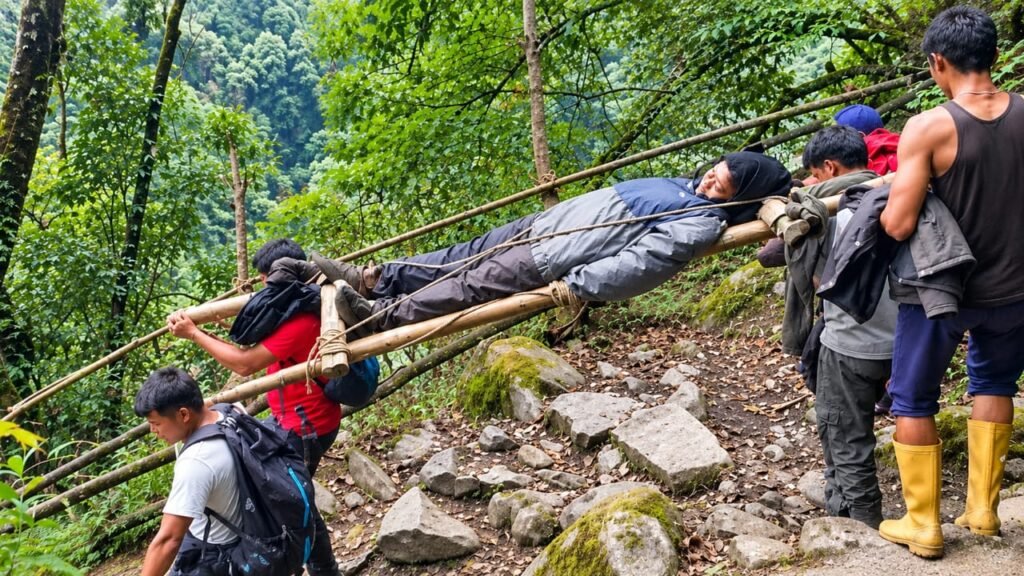
- If the trekker can walk, one or two crew members go with them at their pace. If not, we need more people, and we make a stretcher or carry the person in turns.
- If more hands are needed, our guide asks other trekking staff on the trail for help. Guides, porters and cooks from different Yuksom agencies know each other well, and they do help one another.
- At the road, a vehicle takes the person to the nearest hospital, usually Gyalshing (Geyzing) District Hospital. Larger hospitals are in Gangtok and Siliguri, several hours further by road.
Two honest limits. We cannot give a fixed evacuation time, because distance, weather and manpower decide it. And during the season other crews are busy with their own groups, so extra help is not always available straight away.
Will a helicopter come?
Not as a promise. Three things stand in the way.
- Weather. Cloud and wind in these valleys often ground flights.
- Permissions. Goechala is in a border region, and flights need official clearance.
- Availability and cost. Helicopters are few and expensive.
If one can be arranged in a real emergency, it is arranged then and there, and the cost is paid by the trekker or their insurer. Check this in your policy before you book.
Phone network on the trek
There is some signal at a few points around Tshoka. Beyond Tshoka, on the higher trail, there is no dependable network. Satellite phones are heavily restricted in this border region, so we do not rely on them.
Tell your family before you leave that you may be out of contact for several days. Our trek page says the same: do not count on mobile signal or charging after Yuksom, and carry a charged power bank.
What does an evacuation cost?
Evacuation is not part of any of our three packages. Our Goechala Trek page lists rescue, evacuation, hospital treatment and the cost of an early exit under exclusions. What you pay depends on the case.
- If our own crew can bring you down, we usually manage it by rearranging their work.
- If extra porters are needed, we arrange them as available and agree the payment at that time. As a rough guide only, this can be about ₹2,000 to ₹3,000 per person per Trip. It is not a fixed rescue fee.
- Vehicles, hospital bills and any helicopter are separate and are the trekker’s responsibility.
We can help coordinate during an emergency, but that is not insurance and not a promise of immediate rescue.
Insurance: what to check before you buy
Travel insurance is not included, so please arrange it yourself before you come. A basic travel policy is often not enough. Check that it:
- covers trekking up to at least 5,000 m, since the Goecha La pass is about 4,940 m and Viewpoint 1 is about 4,600 m;
- covers medical treatment and hospital stay;
- covers emergency evacuation, including helicopter and carry-down by crew;
- does not exclude altitude illness or adventure activities.
Keep a printed copy and a phone copy of your policy and the insurer’s emergency number.
Medical fitness certificate
We ask every trekker for a medical fitness certificate from a registered doctor. A permit office may ask for one too. We may decline a booking if the certificate is missing or if a health concern worries us.
Talk to your doctor first if you have a heart or lung condition, high blood pressure, diabetes, epilepsy, or if you are pregnant. Goechala may not be right for you. If you are unsure, compare our shorter Dzongri Trek or read Sikkim Treks: Easy, Moderate and Difficult Routes Compared.
Permits, refunds and early exit
For permits, documents and fees, see our Sikkim permit information. If you leave the trek early or are evacuated, what happens to your payment is covered by our Booking Policy and Refund Policy. Please read both before paying an advance.
What we ask of you
- Train for several weeks with a loaded daypack on stairs and hills.
- Tell your guide at once if you feel unwell. Hiding symptoms is the most common mistake we see.
- Do not climb higher while you have symptoms.
- Carry your own medicines and a copy of the prescription.
- Bring your insurance papers and medical certificate.
- Use our packing checklist and wear boots that are already broken in.
- Be ready for extra costs if an emergency happens.
Frequently asked questions
Is there a helicopter rescue on the Goechala trek? Not guaranteed. It depends on weather, permissions and availability, and the trekker or insurer pays.
Is there mobile network on Goechala? Only at a few points around Tshoka. Beyond that, there is none you can depend on.
What if I get altitude sickness at Dzongri or Lamuney? We stop the climb and watch you closely. If you do not improve, we take you down.
Who pays for evacuation? The trekker, or their insurer if the policy covers it. It is not included in our packages.
How long does it take to reach a hospital? It depends on where you are. On the standard itinerary a healthy group needs about two days to walk from Dzongri to Yuksom, and then there is the road journey.
Can I do Goechala as a first trek? We do not recommend it as an unprepared first trek. Previous multi-day trekking experience is strongly advised.
Does insurance come with the package? No. You must arrange it yourself.
Why trek with a Yuksom-based agency
Go Wild Expedition Tours and Treks is based in Yuksom, where the Goechala trail begins. Our team know the route and the people who work on it, and that matters most on the day something goes wrong.
We cannot promise a quick rescue or a helicopter. We can promise that your safety comes before the viewpoint. The mountain will be there next season.
Ready to plan? See the Goechala Trek or contact us.
Related reading: Goechala Trek guide for international travellers · Altitude Sickness in Sikkim · Best Time to Visit Sikkim · Yuksom Travel Guide