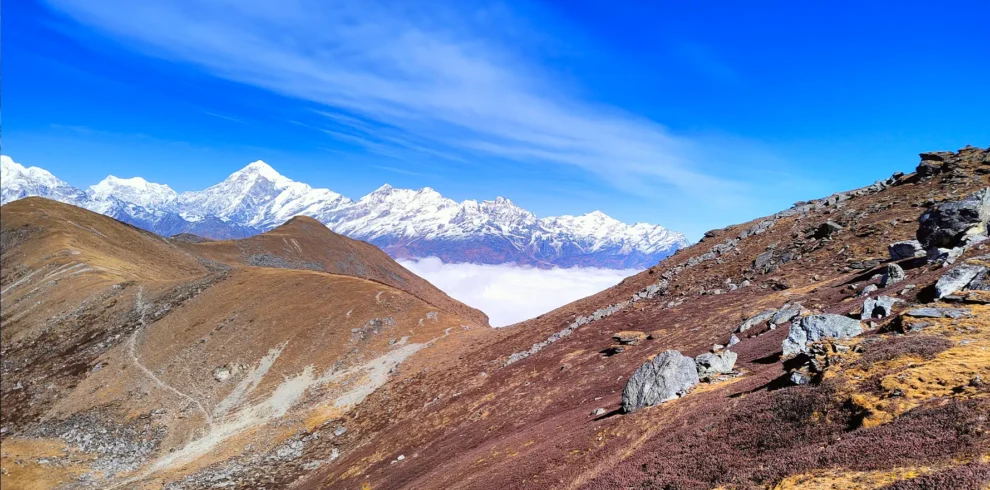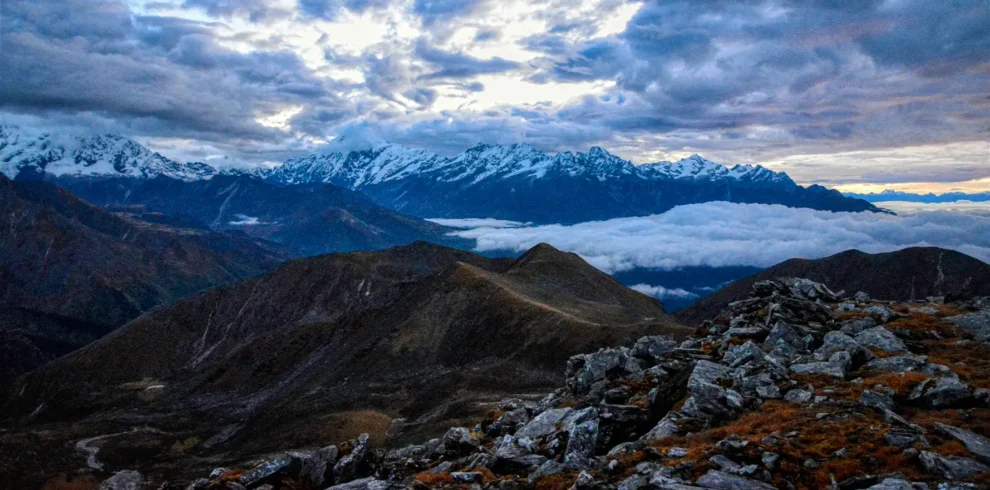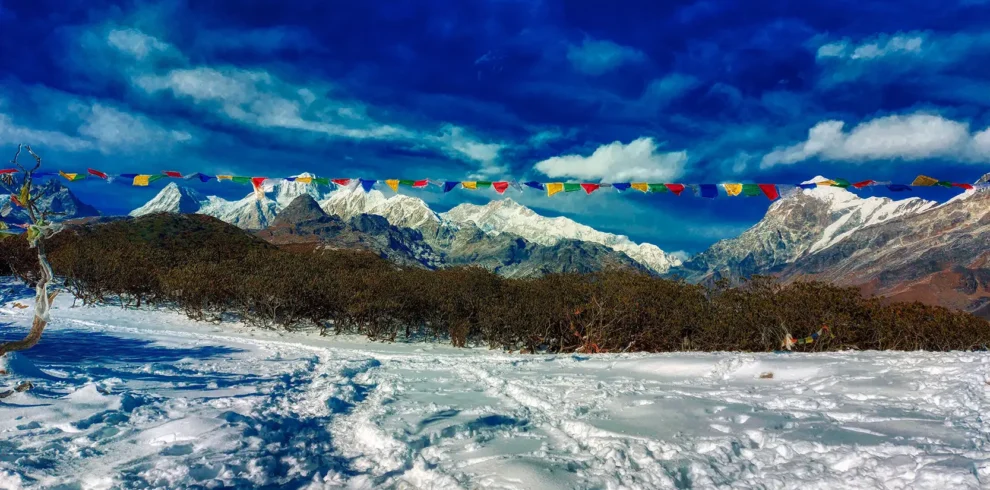
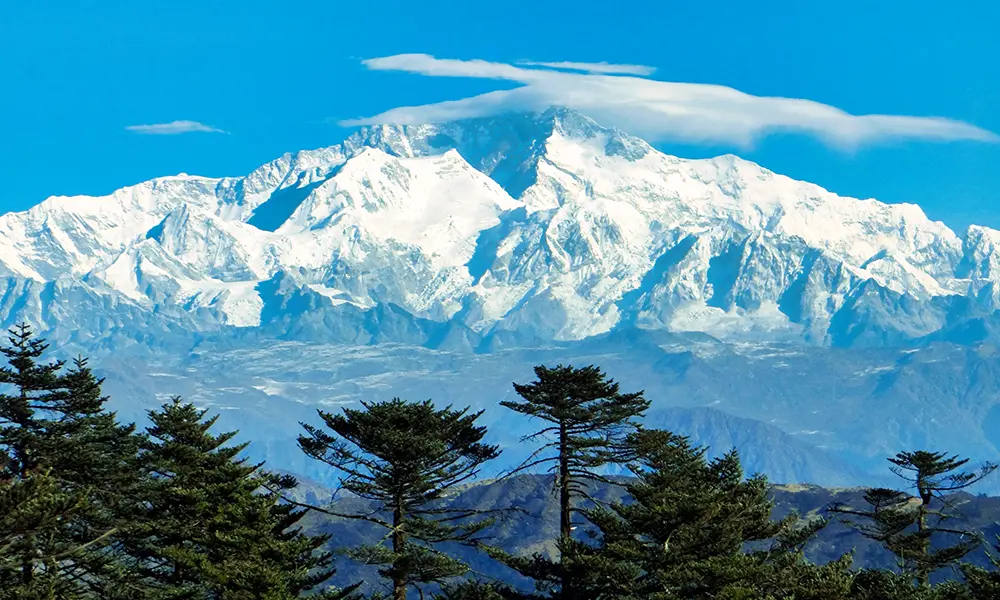
Sandakphu Trek is a Himalayan walking route in Darjeeling that reaches the highest point in West Bengal at approximately 3,636 metres (11,930 feet). The trail climbs onto the Singalila Ridge along the India–Nepal border, passing forests of oak, magnolia and rhododendron, small mountain settlements and exposed viewpoints. On a clear morning, the mountains beyond the ridge include the Kanchenjunga massif and the distant Everest group.
What makes Sandakphu special is the wide mountain panorama rather than a technical summit climb. The peaks around Kanchenjunga form a shape often called the Sleeping Buddha. Farther west, the Everest, Lhotse and Makalu group may come into view when the air is clear. These are long-distance views across Nepal and the eastern Himalayas, not close-up mountains you climb on this trek. Fog, cloud and rain can hide the peaks completely, even in a normally clear season.
Our six-day, five-night Sandakphu trekking itinerary begins with a road transfer from Bagdogra Airport or New Jalpaiguri (NJP) Railway Station to Dhotrey. The walking route then follows Dhotrey → Tumling → Kalipokhri → Sandakphu → Gurdum → Srikhola, with return transport on the last day. Depending on the permitted forest paths and exact lodge locations, the trek covers roughly 40–45 kilometres on foot, spread across four walking days. Accommodation is planned in local homestays, trekking huts or simple lodges at recognised overnight stops.
This is a real trek on foot, not a Land Rover sightseeing tour to Sandakphu. The days include long ascents, uneven stone paths, changing weather and a lengthy downhill walk after the summit. A local trekking guide accompanies the group. Visitors should be prepared for basic mountain accommodation and several hours of walking each day.
What You Will See on the Sandakphu Trek
The Sleeping Buddha range: From certain ridge viewpoints, the peaks around Mount Kanchenjunga form a long silhouette resembling a reclining figure. The outline is most striking in suitable light with little cloud. It is not visible from every point on the route, and no trek can guarantee a clear panorama.
Everest, Lhotse and Makalu: On exceptionally clear days the distant Everest group is visible in another direction. Sandakphu is celebrated for bringing together the Kanchenjunga and Everest mountain groups in one wide horizon, but visibility is weather dependent.
Singalila forests: The lower sections pass through oak, fir, bamboo and rhododendron vegetation. Spring can colour the hillsides with flowers. Wildlife associated with the national park includes red pandas and Himalayan birds, although sightings are rare and must never be promised.
Border villages and mountain food: The route passes settlements and forest checkpoints on the India–Nepal ridge. Local meals may include rice, dal, vegetables, soup and noodle dishes, with simpler menus and limited supplies in the upper villages. You should not assume every tea house has a restaurant-style menu or reliable electricity.
The descent into Gurdum and Srikhola: After the open ridge at Sandakphu, the path drops into wooded valleys and finally towards the Srikhola River. The changing vegetation makes the final walking day rewarding, but the long descent is hard on knees and requires good footwear.
Sandakphu Trek Difficulty and Fitness
The Sandakphu Trek is moderate, not a technical mountaineering expedition. There are no fixed ropes or glacier crossings on the usual route. That does not make it an effortless walk. The Tumling–Kalipokhri day can involve five to seven hours on mixed ground. The climb from Bikheybhanjang towards Sandakphu is steep, and the descent from Sandakphu to Srikhola is long. Altitude and cold winds make the upper stages more tiring.
A fit first-time Himalayan trekker can consider this route with preparation. Before departure, aim to walk briskly for an hour without difficulty and build towards long weekend walks on hills or stairs. Squats, step-ups and controlled downhill walks help strengthen legs for the final descent. Your preparation should match your age, health and previous walking experience. If you have a heart or breathing condition, or a history of altitude problems, obtain suitable medical advice before choosing the trek. The ascent from Tumling through Kalipokhri to Sandakphu should never be rushed if altitude symptoms develop.
Best Time for Sandakphu Trek
March to May: Spring often brings rhododendrons and fresh forest growth. Early mornings may offer good views, but cloud and rain tend to become more common later in the season. April is popular for flowering slopes, while May can be warmer and hazier.
October and November: These are often preferred for clearer post-monsoon mountain panoramas and cool trekking weather. The mornings can be cold at Tumling, Kalipokhri and Sandakphu, particularly when wind picks up. Clear skies remain a matter of weather rather than a promise.
December to early spring: Winter trekking may be possible when the forest route, lodges and transport are operating, but snow, ice and strong winds can make the walking more difficult. Warm gear and flexibility are essential. Singalila National Park is generally closed to routine tourist trekking through much of the monsoon, commonly from mid-June to mid-September. The exact reopening and any temporary restrictions must be confirmed with the forest authorities before travel.
Sandakphu Trek Cost and Group Rates
The indicative starting cost is ₹24,999 per person for two adults travelling together on a privately organised guided trek, with five nights of simple accommodation, the agreed trek meals and Bagdogra/NJP return road transfers. This is a planning estimate rather than a supplier-approved tariff. The final rate depends on travel dates, the number of trekkers, accommodation, transport, forest charges, the number of guides or porters and extra services. A larger group can often receive a lower per-person rate because vehicle and guide costs are shared. Smaller fixed-departure group prices advertised by other operators are not directly comparable with a two-person private arrangement.
The estimate covers the core Sandakphu-only trekking circuit, not an extension to Phalut. Porter or pack-animal services, individual backpack offloading, special accommodation requests and an extended route can be quoted separately. Consult the detailed inclusions and exclusions below to understand the proposed service scope.
Trekking Accommodation, Food and Water
This itinerary uses five overnight stays in recognised villages and trekking stops: Dhotrey, Tumling, Kalipokhri, Sandakphu and Srikhola. Rooms can be shared and facilities basic. Expect cold evenings, limited heating and irregular mobile coverage. Meals are simple, freshly prepared where supplies permit, with vegetarian food commonly available. You should carry a refillable water bottle and follow your guide’s instructions for collecting and treating water.
Although tent camping can be arranged on certain Singalila routes where authorities allow it, this standard package does not promise tents or an unapproved campsite. Any requested camping plan must first be checked against current forest rules, permitted locations, staff and equipment availability. Trekkers should not pitch tents anywhere inside Singalila National Park on their own.
Park Entry, Guides and Border-Route Rules
The route passes through or alongside Singalila National Park and follows sections of the India–Nepal border. Forest entry rules, guide arrangements, charges and permitted overnight locations need to be checked before departure. The standard accommodation sequence may also need changes for foreign nationals because staying at a Nepal-side settlement is not the same as being authorised to cross an international border. We will verify the route and accepted documents for each group rather than treating the border as unrestricted.
For general background, see the West Bengal Tourism page on Singalila National Park and the Darjeeling district trekking information. Detailed application procedures are deliberately kept outside the day-by-day itinerary because they can change.
Packing Essentials
Bring supportive trekking shoes with good grip, a comfortable daypack, warm layers, a windproof and waterproof outer jacket, a cap and gloves for cold mornings, a refillable bottle, personal medication, a headlamp and sun protection. Trekking poles are particularly helpful on the descent towards Gurdum. Pack light enough to walk comfortably for several hours; leave unnecessary luggage behind at an agreed storage point. A guide will advise on bedding, winter traction and extra cold-weather equipment for the actual departure dates.
Sandakphu vs. Sandakphu–Phalut Trek
This package reaches Sandakphu and descends through Gurdum to Srikhola. It is the more manageable choice for travellers who want the classic summit views without spending several additional days along the higher ridge. The Sandakphu–Phalut trek continues north along the Singalila Ridge to another high viewpoint before descending through villages such as Gorkhey and Samanden. That longer expedition adds distance, walking hours and additional overnight arrangements. If the longer ridge walk is your priority, ask for a separate Phalut itinerary rather than assuming it is part of this six-day trek.
Sandakphu Trek is a different experience from our Sikkim mountain expeditions. Travellers comparing trekking regions can also explore the Dzongri Trek or Goechala Trek. See the Trekking activity collection for other walking holidays in the Himalayas.
Trip Facts
-
Lodges / trekkers’ huts · 5N
-
Forest fees per quote
-
Bagdogra / NJP
-
Mar–May · Oct–Nov
-
Bagdogra / NJP
-
Local trekking guide
-
Not included
-
English · Hindi · Nepali
-
Sandakphu · 3,636 m
-
Simple trek meals
-
Bagdogra Airport / NJP
-
Seasonal · park access
-
Transfers + on-foot trek
-
3–8 h on trek days
-
Limited / unreliable
Sandakphu Trek Overview
Sandakphu Trek is a guided six-day trek along the Singalila Ridge in Darjeeling, West Bengal. Reach the state’s highest point at approximately 3,636 metres and, in clear weather, see the Sleeping Buddha silhouette of the Kanchenjunga massif and the distant Everest, Lhotse and Makalu group.
This walking itinerary follows Dhotrey → Tumling → Kalipokhri → Sandakphu → Gurdum → Srikhola, with approximately 40–45 km of trekking across four walking days. Bagdogra Airport or NJP pickup and drop-off are part of the proposed package. Five nights are planned in local lodges, tea houses or homestays; the trek is on foot, not a jeep tour.
The route is moderate, with steep sections, a cold high ridge, and a long final descent. The park access and overnight plan must be confirmed against current forest and border conditions, especially for foreign visitors. The displayed price is an indicative private two-person estimate; seasonal variations, group size and additional support services affect the final cost.
Trek Highlights
- Sandakphu summit at about 3,636 m (11,930 ft)
- Clear-weather views of Kanchenjunga and the Sleeping Buddha range
- Possible distant Everest, Lhotse and Makalu panorama
- Guided trekking through Singalila National Park
- Rhododendron and bamboo forests with seasonal flowers
- Border-ridge villages, local food and simple mountain lodges
- Sacred Kalipokhri pond and the climb via Bikheybhanjang
- Forest descent through Gurdum to riverside Srikhola
- Approximately 40–45 km of walking over four days
- Five overnight stays in local lodges or authorized trekking huts
- Bagdogra Airport or NJP pickup and drop-off included
- Moderate trekking route for prepared walkers
Trip Reviews
No reviews yet. Be the first to share your experience!
Share Your Experience
Rate each aspect of your trip and leave your feedback below.